

Why does business travel strategy need to adapt today?
Because business travel programs no longer operate in predictable cycles. They are continuously evolving as multiple forces shift at the same time, increasing complexity across technology, suppliers, governance, and traveler expectations.
Change has always shaped business travel programs. Supplier agreements evolve. Policies are refined. Technology advances.
What is different today is the scale and overlap of forces influencing business travel at the same time. Business travel programs now sit at the intersection of advancing technology, increasingly complex distribution models, evolving traveler expectations, expanding governance requirements, and ongoing organizational transformation.
This complexity changes the role of business travel strategy. Optimizing a stable travel program is no longer enough. Strategy must provide clear direction while conditions continue to shift, ensuring compliance, financial control, and stakeholder confidence are maintained.
Managing change across your travel program?
Why change matters for business travel strategy
When change becomes continuous, it affects more than individual tools or processes. It affects how consistently a travel program performs across governance, cost control, and traveler experience.
Travel strategy sets the direction for how travel programs operate and align with broader business objectives. When the environment is shifting, that strategy must adapt with it. If it does not, the signs are familiar. Adoption declines. Workarounds increase. Policy leakage grows. Stakeholders begin to question the program’s value.
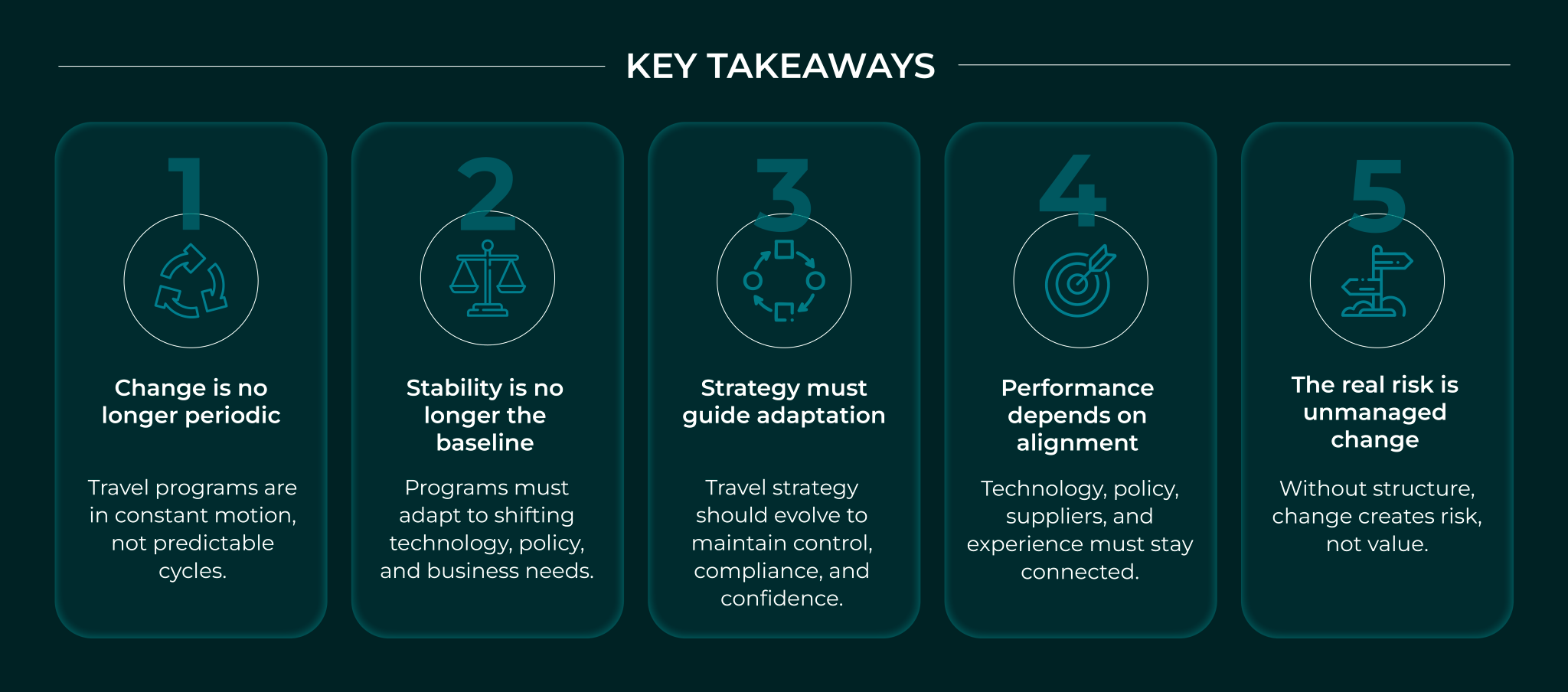
Change itself is not the issue. Unmanaged change is.
The real challenge is ensuring that the strategy evolves with the same discipline as the program it governs.
The role of structured support
In this environment, travel managers are increasingly looking for structured support to guide change across their programs.
1000 Mile Travel Group helps bring that structure by aligning technology, supplier strategy, policy, and communication into a coordinated approach. This ensures that change is introduced clearly, adopted consistently, and sustained over time, supporting program performance rather than creating fragmentation across regions or teams.
5 themes driving change in business travel programs
Travel programs are no longer adjusted every few years in response to major events. They are continually evolving. Several forces are reshaping business travel programs at the same time. Each introduces new complexity. Together, they create constant motion.
1.Technology evolution
Travel technology continues to advance rapidly, introducing new capabilities across booking, reporting, automation, intelligence, and traveler support.
Enhancements are increasingly incremental and integrated into broader workplace systems. Booking tools connect with collaboration platforms. Data expectations expand. Automation improves efficiency. These developments strengthen travel programs when adopted effectively. They also require clear strategic alignment to account for evolving workflows and stakeholder expectations.
2.Distribution complexity
Air and hotel distribution models are becoming more dynamic and less uniform. Pricing structures evolve. Content sources diversify. Booking pathways vary across regions.
Business travel programs must balance access to competitive content with transparency, policy compliance, and reporting consistency. This complexity is particularly visible in global environments, where oversight and user experience must remain aligned across regions.
As content distribution evolves, travel managers must determine how those shifts align with cost objectives and governance requirements.
3.Changing traveler expectations
Today’s business travelers compare their corporate travel experience not only to previous internal programs, but to broader digital standards.
They expect intuitive tools, flexibility, and support for productivity and well-being. When the travel experience feels disconnected from how people work today, compliance and adoption can weaken.
Business travel programs are increasingly evaluated not only on financial performance, but also on how well they support traveler confidence.
4.Governance and responsibility
Duty of care obligations, sustainability commitments, data privacy requirements, and regulatory expectations continue to expand.
These factors influence travel program design, supplier selection, reporting frameworks, and communication practices. Even relatively small program adjustments can have broader implications for oversight and compliance.
5.Organizational transformation
Organizations are changing faster than many travel programs were originally built to accommodate.
Mergers, acquisitions, restructuring, and geographic expansion frequently require travel programs to integrate, scale, or consolidate at speed.
In many cases, business travel programs are expected to adapt in parallel with organization transformation. Business travel strategy must therefore provide direction during periods of internal change, ensuring that adaptation does not compromise control or visibility.
Managing change across complex travel environments
In large, multi-region travel programs, change rarely happens in isolation. Technology updates, supplier changes, and organizational shifts often occur at the same time.
Without a clear structure, these changes can be implemented differently across regions, leading to inconsistent traveler experiences, reduced visibility, and challenges in maintaining policy alignment.
This is where a coordinated approach to business travel strategy becomes critical to ensure consistency, control, and performance across the program. For many organizations, this coordination is supported through partners like 1000MTG, who help ensure changes are implemented consistently across regions while maintaining visibility and control.
A new baseline for travel leaders
Taken together, these forces create a clear reality. Business travel programs are operating in a landscape of continuous change.
For travel managers and stakeholders, this alters expectations. Sustaining performance requires alignment across technology, suppliers, governance, policy, and communication. The question is no longer whether change will occur. It is whether the business travel strategy is designed to guide that change deliberately and consistently.
In a more complex travel environment, business travel strategy must adapt deliberately to protect travel program performance, maintain control, and sustain long-term value.
Download the eBook, Managing Change in Modern Travel Programs, to keep your business travel program aligned, adopted, and performing.
Build a business travel strategy designed for change.
Connect with 1000MTG to strengthen alignment, control, and performance across your travel program.