

Travel disruption in the Middle East: guidance for business travelers
Airlines across parts of the Middle East continue working through capacity constraints following recent airspace disruptions and temporary operational pauses. As a result, flight disruptions across the Middle East have left outbound flights heavily booked while carriers reposition aircraft and crews.
Airline disruptions can leave travelers waiting several days for available flights, especially when major global hubs temporarily reduce operations. When flights resume after airspace closures or operational disruptions, seats may remain limited while airlines work through a backlog of passengers.
For travelers currently waiting to depart from parts of the Middle East, the following practical steps may help improve the chances of securing a seat as commercial service gradually resumes.
Support for 1000MTG travelers
1000MTG continue to monitor airline operations, airspace developments, and government advisories across the region.
Travelers and customers should remain in contact with their 1000MTG travel advisor for assistance with rebooking, travel planning, and operational updates.
Why seats may remain limited after flight disruptions in the Middle East
Major Middle Eastern aviation hubs handle extremely large passenger volumes under normal conditions.
When airspace restrictions or operational disruptions occur, even a short pause can create a significant backlog of travelers waiting to depart. Airlines must reposition aircraft, crews, and passengers before schedules can fully normalize, which is why flights may remain heavily booked (and over-booked) for several days after operations resume.
Stay informed about schedule changes
As airlines work to restore normal operations following recent airspace disruptions across parts of the Middle East, schedules may continue to change while carriers reposition aircraft, crews, and passengers. During periods of flight disruption in the Middle East, travelers who monitor updates closely may be better positioned to respond quickly if seats become available, or itineraries are adjusted.
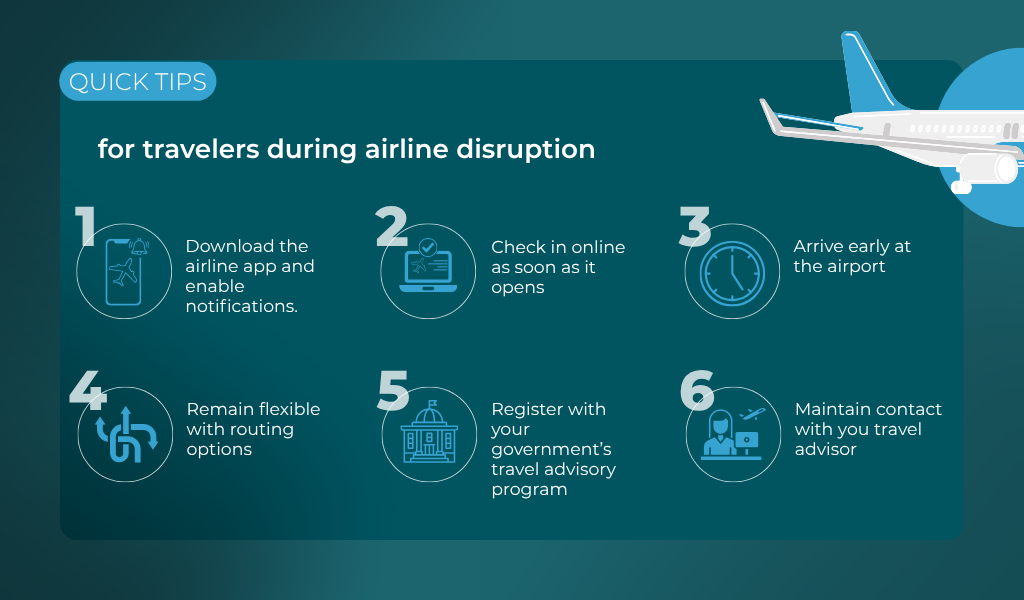
- Download the airline app and sign in: Travelers should download the airline’s official mobile app and sign in to their reservation rather than accessing it as a guest. This ensures they receive real-time notifications when check-in opens; flights change, or seats become available.
- Monitor your booking regularly: During periods of disruption, airlines may adjust schedules multiple times as operations stabalize. Travellers should check their booking on the airline’s website or app for schedule changes or cancellations. If changes appear, they should notify their travel management company immediately so alternative options can be explored quickly.
- Keep app notifications enabled: Airlines may release additional seats or adjust passenger allocations as aircraft and crews return to operations with limited notice. Keeping devices charged and notifications enabled allows travelers to respond quickly if changes occur.
- Maintain contact with your travel advisor: Corporate travelers should keep in close contact with their travel advisor during periods of airline disruption. They can help monitor schedule changes, explore alternative routing options, and assist with rebooking as flights change faster than individual travelers.
Steps to improve boarding priority
When flights are operating at or near full capacity, small actions can help improve the likelihood of boarding.
- Check in online as early as possible: Online check-in typically opens about 24 hours before departure. Travelers who check in early may have a better chance of securing a seat on flights operating at full capacity.
- Confirm frequent flyer status after rebooking: If a traveler has been rebooked or purchased a new ticket, it is worth confirming that frequent flyer status remains attached to the reservation. Elite status can influence boarding priority if flights are oversubscribed.
- Arrive early at the airport: Travelers who arrive earlier may have a greater chance of being accommodated if operational adjustments occur.
- Go directly to the departure gate: After clearing security, travelers should proceed directly to the gate so they can speak with airline staff if boarding priorities or seat assignments change.
- Be flexible with travel routing: Flexibility can often help travelers depart sooner during disruptions.
- Consider alternate routes or connecting flights: Travelers may find earlier options by accepting multi-stop itineraries or connections through alternate hubs rather than waiting for a direct flight.
- Check nearby airports: In some situations, nearby regional airports may offer available seats sooner than the primary hub. For example, travelers departing from Dubai may find additional options through nearby airports such as Abu Dhabi or other regional gateways.
Register with your government for travel alerts
Many governments offer voluntary travel registration programs that allow citizens traveling abroad to receive safety alerts from embassies and consulates. These programs also enable officials to contact travelers during emergencies or evacuation planning. When offered, they also open up access to any country-sponsored repatriation flights that may be deployed by individual countries to support citizens abroad.
Travelers may wish to register with their home government before or during international trips.
Government travel registration programs:
United States
Smart Traveler Enrollment Program (STEP)
https://mytravel.state.gov/s/step
Canada
Registration of Canadians Abroad (ROCA)
https://travel.gc.ca/travelling/registration
France
ARIANE traveler registration system
https://fildariane.diplomatie.gouv.fr
Germany
ELEFAND – Electronic Registration of Germans Abroad
https://elefand.diplo.de
United Kingdom
Foreign travel advice and alert service
https://www.gov.uk/foreign-travel-advice
Australia
Smartraveller travel alerts and crisis registration
https://www.smartraveller.gov.au
New Zealand
SafeTravel traveler registration
https://www.safetravel.govt.nz
Japan
Tabi-Regi travel registration system
https://www.ezairyu.mofa.go.jp/tabireg
Taiwan
Overseas travel registration (Ministry of Foreign Affairs)
https://www.boca.gov.tw
China
Chinese citizens are generally advised to register travel with their embassy or consulate through official consular service platforms.